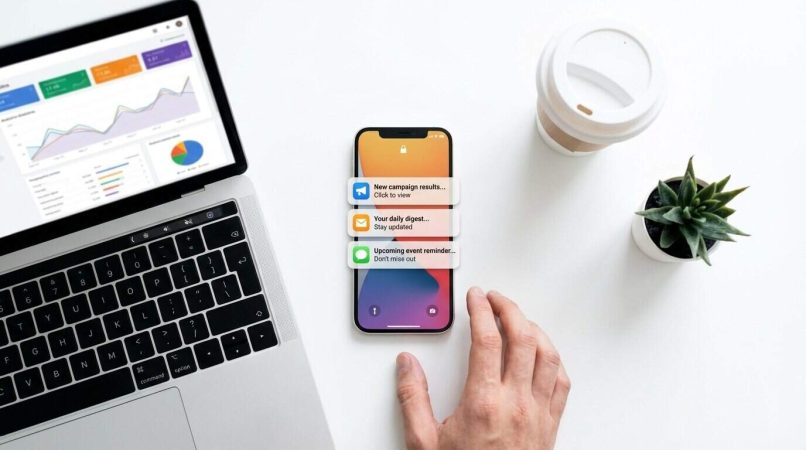
Push notification marketing is one of the most direct ways to reach your audience in 2026. There’s no inbox sorting your updates into a promotions tab, just a notification on a lock screen the moment you hit send.
If you’re a brand, create content, or manage an audience of any size, push notifications should already be part of your marketing stack. If they are not, you are leaving attention and revenue on the table.
Let’s cover everything you need to know about push notification marketing: how it works, the different channels available, what is actually performing right now, and how to pick the right approach for your business.
What Is Push Notification Marketing and Why Does It Work?
Push notification marketing is the practice of sending short, targeted messages directly to a person’s device. These messages appear on the lock screen or notification center of a phone, tablet, or desktop without the recipient needing to open an app or check an email.
One important distinction before we go any further: desktop push notifications and mobile push notifications are completely different things. Desktop push notifications are a nuisance. People block them almost immediately.
Mobile push notifications, the kind that arrive on the phone someone carries everywhere, are a completely different channel, and people see them in a way they rarely see a marketing email. When we talk about push notification marketing, we mean mobile push notification marketing.
The reason mobile push works is simple. It meets people where they already are: on their phone, dozens of times a day. Unlike email (which competes with hundreds of other messages in an inbox) or a social feed (where every post competes with everyone else’s), a push notification arrives instantly and visibly.
Here’s why marketers are paying attention.
- Push notifications go straight to the lock screen rather than into a crowded inbox, so far more people see them and click through. The average marketing email is clicked by only about 2.6% of the people it’s sent to, according to Mailchimp’s 2023 benchmarks ↗.
- A wallet pass notification reaches every lock screen that has the pass, while email keeps losing ground to spam filters and inbox tabs.
- According to Reviews.org, the average American checks their phone 186 times a day. Push notifications arrive right in the middle of that habit.
For brands and creators, this is a direct line to your audience that does not depend on a third party deciding whether your message gets seen.
The Three Types of Push Notifications Every Marketer Should Know
Not all push notifications are created equal. There are three main channels, and each one works differently. Understanding the differences will help you choose the right one for your business.
App Push Notifications
If you have a mobile app, you can send push notifications to anyone who has installed it and opted in. App push notifications are powerful because they can be triggered by user behavior (location, in-app activity, purchase history) and they work even when the app is closed.
The catch? Your audience has to download your app first, and plenty of people open a new app once and never come back. Only around 4 to 5% of downloads are still in use a month later, according to AppsFlyer data. If your audience is not already committed to using your app daily, the reach of app push drops fast.
App push works best for large brands with loyal user bases (think retail apps, banking, food delivery) where the app itself is part of the product experience.
Web Push Notifications
Web push notifications are sent through desktop and laptop browsers. A visitor arrives on your website, a prompt asks if they want to receive notifications, and if they accept, you can message them even when they are not on your site. The notifications pop up in the corner of their screen, just like a system message.
Web push took off because it removed the need for a mobile app entirely. For publishers, bloggers, and ecommerce stores, it was a quick way to build a subscriber base without the cost and complexity of app development.
But web push has hit some serious headwinds. Most people find desktop notifications annoying and block the permission prompt at first sight. Browsers keep tightening the rules on notification prompts, making it even harder to get that initial opt-in. And when someone does accept, the notification only reaches them when they are sitting at their computer.
For B2B publishers, news sites, and businesses with desktop heavy audiences, web push still has a role. But it is fundamentally a “people at their desk” channel, which limits its reach in a context where most digital attention has shifted to the phone in someone’s pocket.
Wallet Pass Push Notifications
This is the newest channel, and it is where the momentum is heading.
Wallet pass push notifications work through Apple Wallet and Google Wallet, the native apps already installed on almost every smartphone. Instead of asking someone to download your app or accept a browser prompt, you give them a branded digital pass.
They add it to their wallet in one tap (via a QR code scan or a link click), and from that moment on, you can send push notifications directly to their lock screen.
No app to build. No app to maintain. No browser permission to manage. The pass sits alongside their credit cards and boarding passes, so it stays in their wallet between messages. And because it uses the wallet already on their phone, every notification reaches the lock screen of everyone who has the pass.
Wallet pass push notifications are being adopted by brands, creators, music artists, restaurants, salons, and anyone who wants a direct notification channel without the overhead of a mobile app. It is push notification marketing with the lowest possible barrier to entry for both the sender and the recipient.
Push Notification Marketing vs Email, SMS, and Social Media
Every marketing channel has tradeoffs. Here is how push notification marketing stacks up against the other channels you are probably already using.
Push Notifications vs Email Marketing
Email is not going away. But it is getting harder to reach people through it. Fewer people open marketing emails every year, and younger audiences check their inboxes least of all. Spam filters, promotions tabs, and inbox fatigue mean your carefully written email often goes unread.
Push notifications bypass all of that. There is no spam filter. There is no promotions tab. The message appears on the lock screen the moment you send it. That does not mean you should replace email with push. It means you should use both. Send the detailed newsletter via email. Send the time sensitive alert via push. The two channels serve different purposes, and together they cover more ground than either one alone.
Push Notifications vs SMS Marketing
SMS gets read, but it comes with a cost problem. Every message costs money. Carrier filtering is getting more aggressive. And with iOS introducing smarter spam detection that pushes marketing SMS to a separate inbox, the channel’s reliability is under pressure.
Wallet pass push notifications deliver to the lock screen just like SMS, but there is no per-message cost, and pricing grows with your audience rather than with every message you send. For brands sending updates like product drops, loyalty reminders, and flash sales,
wallet pass notifications reach far more people than SMS, without a charge for every message.
Push Notifications vs Social Media
Social media is brilliant for being discovered, but you build a following and the platform decides how many of them see each post. Organic reach has fallen so far that on the biggest platforms the average post reaches fewer than 5% of followers, according to Socialinsider, and even people who asked to be notified often aren’t.
That is why social works best alongside a channel you own. Keep posting to be found, and give the people who like what they find your pass, so you can reach them directly.
Push notification marketing gives you a direct channel to the lock screen, with no spam filter in the way. When you send a notification, it reaches the lock screen of everyone who has the pass. That is the difference between owning your audience and renting it.
How Brands and Creators Use Push Notification Marketing in 2026
Push notification marketing is not a single use case. The way you use it depends entirely on who you are trying to reach and what action you want them to take.
Ecommerce and Retail Brands
Retail brands and online stores use push notifications to drive repeat purchases, often as part of an ecommerce loyalty program. Flash sale alerts. Back in stock notifications. Loyalty point reminders. Abandoned cart nudges. Timing is everything, and a notification about a 24-hour sale reaches the lock screen while the sale is still on, rather than sitting unopened in an inbox.
Brands using wallet pass push notifications add another layer. The branded pass in the customer’s wallet works as both a loyalty card and a notification channel. A coffee shop sends a push when the customer is near the store. A clothing brand with a
boutique loyalty program sends a notification when new items are in stock. A brand pass stays in your audience’s wallet, keeping the brand top of mind between purchases.
Content Creators and Influencers
For creators, push notification marketing solves the reach problem. Subscriber notifications are unreliable, fewer young fans open newsletters, and social posts get buried fast.
A creator who puts a wallet pass link in their video description or displays a QR code on screen gives their audience a one-tap way to opt into lock screen notifications. When a new video goes live, the creator sends a notification to the lock screen of everyone who has the pass, with a link to the video.
This matters even more when you consider that TV is now the main screen for watching YouTube in the US, according to
YouTube ↗. When someone watches on a TV, they cannot click the link in the description. It is useless. The only bridge between the TV screen and the viewer’s phone is a QR code displayed in the video itself. That QR code needs to lead somewhere worth the effort, and a wallet pass added in one tap is the fastest possible outcome.
Music Artists and Entertainment
Music artists have a unique challenge. Their fans are passionate, but the communication channels they use are controlled by platforms. Those platforms decide who sees each tour announcement and release date.
A branded wallet pass gives music artists a direct line to their fans. New single dropping Friday? Send a push to every fan who added the pass. Tour dates announced? Push notification with a link to tickets. Merch drop? Push it to the lock screen. The pass also doubles as a loyalty tool, rewarding fans with points for attending shows, buying merch, or sharing the pass with friends.
Restaurants, Salons, and Local Businesses
For local businesses, push notification marketing replaces the paper punch card and the “download our app” request. A QR code on the counter or on a receipt lets customers add a branded wallet pass with one single tap. From then on, the business can send weekly specials, loyalty rewards, appointment reminders, or seasonal promotions directly to the lock screen.
Consider restaurants. Many are paying delivery apps up to 30% of every order, including orders from regular customers who already know the restaurant by name. That’s DoorDash’s top commission rate. Those customers would order directly if the restaurant gave them a reason. A wallet pass with push notifications is the reason. A weekly special, a new menu item, a loyalty reward, all delivered to the lock screen.
No app required. No email address collected. No phone number needed. The customer taps, the pass is in their wallet, and the relationship begins.
How QR Codes Turn Every Touchpoint Into a Push Notification Subscriber
Most brands treat QR codes as links. Scan the code, visit the website. That is the extent of it. The person scans the page for three seconds, closes the tab, and the relationship is over.
That is an extraordinary waste of a moment of intent. Someone picked up their phone and pointed it at your code. That is an action that required effort. It means they are interested. Sending them to a homepage that they close in seconds is entirely wasting that intent.
When a QR code opens a wallet pass instead of loading a website, the scan becomes the beginning of a relationship, not the end. The person taps, the pass is in their wallet, and now you have a push notification channel to their lock screen that stays for as long as they keep the pass.
Every piece of packaging, every billboard, every bus stop poster, every YouTube video or TV ad, every event wristband, every table tent in a restaurant is a potential subscriber capture point. Most brands treat these touchpoints as one-off impressions. A QR code linked to a wallet pass turns each one into the start of a direct, push notification-enabled relationship.
The difference in scan-through rates is dramatic. QR codes that link to websites get little engagement. With the right call to action (think “scan to become a VIP member” rather than “scan to visit our website”), wallet pass QR codes capture far more people. The difference is not the QR code. It is what happens after the scan. Perceived value and low commitment. That is the formula.
Stop measuring your marketing in impressions. Start measuring it in subscribers captured.
Push Notification Marketing Best Practices
Segment Your Audience Before You Send
Not every message is for every subscriber. Segment your audience based on behavior, preferences, location, or purchase history. A notification about a flash sale on winter coats should go to people who have browsed winter coats, not to your entire list. The more relevant the notification, the higher the engagement and the lower the unsubscribe rate.
Respect Frequency (Do Not Over Send)
The fastest way to lose a push subscriber is to send too many notifications. There is no universal magic number, so test what works for your audience. Pay attention to your opt-out rates. If they spike after a high-frequency week, scale back.
Write Like a Human, Not a Marketing Department
Push notifications are short. Only the first line or two shows at a glance. Every word matters. Write the way you would text a friend. Skip the corporate language. Skip the ALL CAPS urgency tactics. Be direct, be specific, and give the reader a reason to tap.
Good: “New episode is live. This one’s about the worst business advice we ever got.”
Bad: “EXCITING NEW CONTENT ALERT! Don’t miss our latest episode NOW!”
Time Your Notifications Based on Your Audience
A push notification sent at 3am is not a notification, it is an annoyance. Send during the hours when your audience is active. For B2C brands, that is typically late morning or early evening. For creators, it is whenever your audience is most likely to watch or read. Most push notification platforms let you send in the recipient’s local time zone, and you should always use that feature.
Use Push Alongside Your Other Channels
Push notification marketing works best when it is part of a larger strategy, not the entire strategy. Use email for long form content and detailed announcements. Use social media to build community and discover. Use push notifications for time-sensitive, action oriented messages that need immediate attention. The channels are not competitors. They are teammates.
How to Get Started With Push Notification Marketing
If you are ready to add push notifications to your marketing, here’s what you need to consider.
If you already have a mobile app with a large, active user base, app push notifications are the obvious choice. You have the infrastructure already.
If your audience is on a desktop, web push notifications still work in some circumstances, especially for timely news notifications.
If you want push notifications without building an app, wallet pass push notifications are the fastest path. You create a branded pass, share a link or QR code, and your audience adds it to Apple Wallet or Google Wallet in one tap. From there, you can send push notifications straight to their lock screen. No app store submission. No app maintenance. No downloads for your audience to forget about.
The barrier to entry for push notification marketing has never been lower. The tools exist. The audience behavior supports it. And the brands and creators who are building direct notification channels now are the ones who will still have a direct line to their audience whatever changes elsewhere.
Your followers only see what a platform chooses to show them, and your email subscribers are one promotions tab away from never seeing your message again. But a push notification subscriber who added your pass to their wallet? That is someone you can reach directly, on the most personal device they own, any time you have something worth saying.
Your audience is already looking at their lock screen. The question is whether your brand is on it.
Want to know more? PushPass might be the solution. See how our
push notification platform reaches every lock screen with no app.