
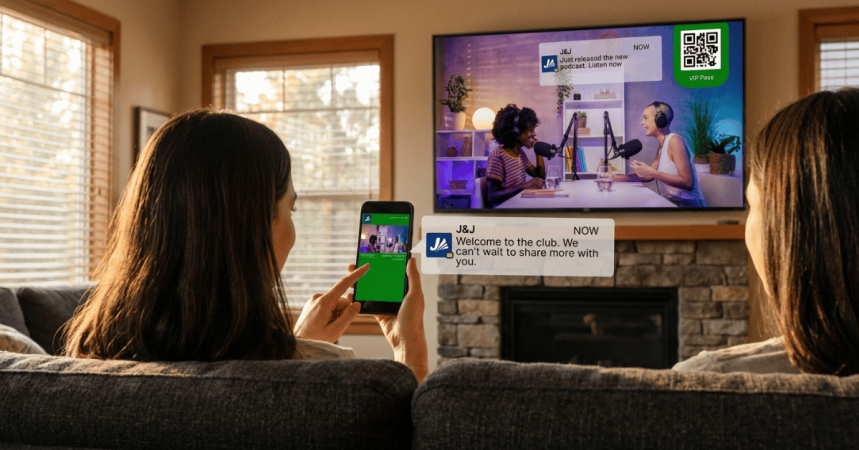
Influencer attribution breaks down on YouTube TV because there is no call to action that is soft enough to meet viewers in the right moment. This is the approach push notification software is built around. When someone is sitting on their sofa, relaxed and watching YouTube or any other channel on a TV, there is rarely a natural or compelling action to take. It’s no surprise that scan-through rates in this context are low.
The core issue is that TV viewers are not in buying mode. The real problem to solve is how to activate the viewers watching on television screens, where more than half of YouTube viewing now happens. Without a clear signal of intent, attribution becomes problematic for brand sponsors and agencies alike, and conversion data quickly becomes blurred and difficult to measure.
Attribution on mobile or desktop is far more straightforward than on TV. A link in the description can carry affiliate tracking, and the destination is much easier for the viewer to act on in the moment. This issue isn’t about anything being wrong with the creator or the campaign itself, but about the funnel. For TV viewers, that funnel is often fundamentally weak because the call to action does not match the viewing context, which leads to consistently low QR code scan rates.
YouTube Is Now a TV Platform, Not a Website
YouTube is now one of the most watched TV apps globally. And as CEO Neal Mohan confirmed, more than half of YouTube viewing now happens on connected TVs. This behavior is very different to how people watch on their other devices. This is now a mainstream problem, not a niche issue. When it comes to brand sponsorships and activating connections with viewers, the rails for attribution are, of course, already in place, but when the QR code asks for too much, the measurement and conversion problems need to be addressed. It’s timing and intent. That’s the core of the issue.
What Actually Happens When Someone Watches on TV
When viewers are watching YouTube on their TV, they’re typically in a laid-back viewing mode. This doesn’t mean they don’t notice an offer, whether that’s a brand sponsorship or an influencer promotion. They simply can’t click it. And even when a QR code is shown, the real question is whether a viewer is likely to act on it while relaxing on the sofa.
This also doesn’t mean the brand is forgotten. Instead, the viewer is left needing to remember to act later. The longer the gap between exposure and action, the less likely that action is to happen at all.
Why Links, UTMs, and Discount Codes Fail on TV
Traditional attribution tools rely heavily on immediacy, which means they require a click. When that click is easy, there’s an opportunity to drop UTM parameters and of course tracking links. Discount codes can be copy-pasted, and a sale becomes more likely. Of course, once the click has taken place, attribution and retargeting become much easier, reducing costs on re-engagement and customers who are more likely to be engaged with the brand.
The Attribution Gap Brands Rarely See in Reports
This is where attribution becomes tricky. Of course, in the old world, brand exposure on billboards or traditional TV always had this issue. Conversions still happened, but not in ways that were as traceable as they are today. Affiliate tracking changed all of that many years ago. The real issue isn’t the creator, the sponsorship, or even the platform. It’s the missing conversion layer in TV campaigns that sits between exposure and measurable intent.
The other issue that TV viewing causes in terms of attribution is how the touchpoint can change. If the viewer later searches for your brand due to the demand that has been captured by the creator, you could well be paying twice for that same customer.
Why This Is a Financial Problem, Not a Marketing One
Attribution can sound like a marketing inconvenience rather than a serious issue, but when the link to the viewer is broken or messy, reporting becomes unreliable and campaigns become difficult to measure. That quickly turns into a financial decision when it comes to budgeting campaigns with YouTubers, other video creators or agencies. As influencer marketing now sits alongside paid search and social media as a performance channel, this problem is only becoming more significant.
The more accurate influencer attribution is, the more confidently budgets can be set and scaled. As a performance channel, influencer marketing needs to be proven both effective and cost-effective, not just for the brand but when deciding who to work with again. The real question becomes whether a campaign was genuinely successful and whether the spend can be justified another time. Finance teams are not looking for perfection, but attribution matters because without it, campaign spend cannot be defended. It is difficult to increase investment in a channel when you cannot clearly show how customers were acquired, regardless of how strong the creative or the creators were.
Why Better Reporting Alone Does Not Fix This
When the TV attribution problem is first recognized, it’s instinctive to look for better reporting rather than for different conversion approaches.
It feels logical to assume that if the numbers don’t line up, the solution must be more advanced dashboards and better analytics.
But the reality is that reporting tools can only work when the data already exists. They can’t measure attribution if there’s no signal of that in the first place. What’s happening on YouTube TV is part of a wider connected TV attribution problem that brands are only just starting to recognize. So, when it comes to a YouTube video or a TV ad being watched on the big screen and optimization of a QR code isn’t helping with analytics, there is a natural gap that will only become worse over time.
What a Trackable TV-Safe Conversion Signal Looks Like
The core issue with TV viewers, on YouTube and every other channel, isn’t that people are disengaged; it’s that they’re not being reached at the moment they’re most likely to want to interact with purchase intent. This doesn’t mean they don’t want to engage with the brand or the influencer. It simply means they want less of a hard sell while they’re in a laid-back viewing mode.
The call to action therefore needs to support a “save now, act later” mindset. It also needs to be as frictionless as possible, while creating a connection with the viewer that lasts beyond the viewing session. A one-off interaction is rarely enough in this context, and unlike desktop or mobile website visits, the connection should live on the viewer’s phone, where future interactions can happen through notifications.
Without this type of infrastructure, conversions are unlikely to occur because the moment of intent is short-lived. A website visit relies on immediacy and active intent from the TV viewer, which is rarely present. In practice, this means the conversion signal needs to function more like an install or opt-in than a visit. Even an app install at that stage is often too much friction, and a website visit is usually fleeting. Converting that initial interest into a meaningful, persistent connection is the only attribution that can be measured reliably. One way to achieve this is through mechanisms similar to how digital membership cards work in Google or Apple Wallets.
Where Brands Go Next
The problem with TV-based campaigns isn’t usually the creative or the media buy. It’s the conversion layer. Solving it means capturing intent while the viewer is still watching and removing any unnecessary friction that gives them a reason not to interact.
For TV viewers, homepage visits and purchase-intent QR codes don’t fix the issue. It’s important to distinguish between TV viewing and mobile or desktop behavior, because they are fundamentally different environments. Brands that adapt here stop trying to make TV behave like the web and instead build conversion paths that respect how TV is actually watched and used. When a QR code opens up push notification marketing with a single scan, it can transform a campaign.
Brands dealing with this problem typically start by exploring YouTube attribution solutions for brands designed specifically for TV viewing. Not because they need new technology for its own sake, but because they need a conversion signal that fits the medium. When that signal aligns with real viewer behavior, it captures far more of the audience.
A 15-minute call. Your brand on your lock screen before it ends.


