
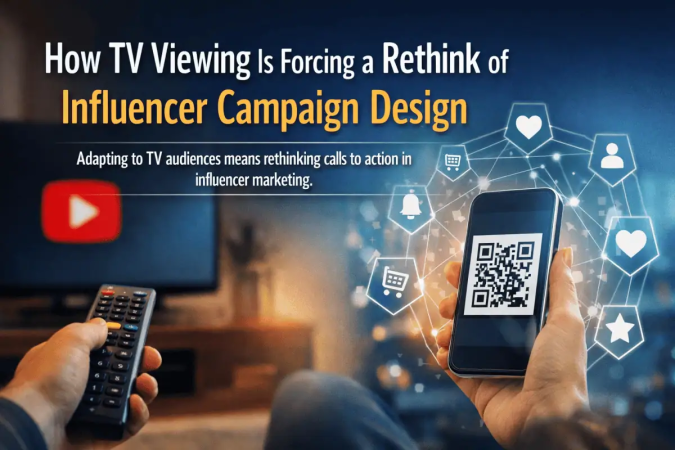
Influencer campaign design has quietly relied on one assumption for years. But that one assumption doesn’t work for TV audiences, whether they’re watching YouTube or any other channel.
The assumption has always been that a click in the description should have the same action as a QR code, and that’s not the case when the audience is in a completely different viewing mode.
As YouTube increasingly behaves like a TV channel, campaign design has to change with it.
YouTube Is No Longer Primarily a Click Driven Platform
More than half of YouTube viewing now happens on TVs. It fundamentally changes how audiences interact with content on YouTube.
TV viewers are watching, not browsing. They are relaxed, passive, and focused on the screen in front of them.
The result is that many of the interaction mechanics that influencer campaigns rely on are no longer available to a large portion of the audience. Of course, QR codes are still available, but often are not thought of as a separate action to a click, when in fact they are a very different interaction, and this matters.
Why Traditional Campaign Design Breaks on TV
Most influencer campaigns are still designed around mobile and desktop behavior.
Now, this doesn’t work well on TV campaigns because there is no description to add a link to or a page to reach. Those don’t typically happen on a TV.
These, of course, only work when the viewer is on a phone or laptop.
Viewers on TV or second devices can’t click links. They can’t easily move into a conversion flow. Even if the intent exists, the pathways are broken or often poorly administered.
This shift in viewing behavior has broken the influencer attribution model that most campaigns still depend on.
The Cost of Ignoring TV Viewers
Why Campaign Design Has to Become Action Aware
The solution is not to push harder. It is to design campaigns around what viewers can realistically do in the moment and in fact, what they want to do in that laid-back mode
This is why QR codes have become essential rather than optional, but simply adding a QR code doesn’t solve the problem on its own. This is why QR codes underperform on YouTube and TV when treated as conversion tools rather than as moment-appropriate actions. The call to action is the most important factor, and if that is too much of an ask from a TV viewer, the QR code will get few scans and therefore low conversion rates.
When QR codes are used as high-pressure conversion tools, scan rates are low. When they are used as low-friction actions that match the viewing moment, performance improves dramatically. This behavior is about how the viewer watches. However, with the right type of QR code and call to action, often with the help of the presenter, you capture far more of your audience.
Why QR Codes Need a Different Role on TV
Most QR codes shown in influencer campaigns still treat the scan as a conversion event most often with a “Buy Now” or “Sign Up” link.
This assumes the viewer is focused on a buy or sign-up action that rarely exists when someone is watching YouTube on a TV. The viewer is relaxed, often watching passively, and not in a decision-making frame of mind. When a QR code asks for too much in that moment, it creates friction rather than action.
This is why underperforming QR codes on YouTube and TV ads are usually not a technology issue. They fail because they are being used like checkout buttons in an environment that does not support that behavior.
On TV, QR codes work best when they are repositioned as a lightweight way to continue the relationship, not as a demand to act immediately.
Designing for the Moment, Not the Outcome
Effective campaign design starts by respecting the moment the viewer is in while watching.
The key thing here is TV viewing is not a buying moment. It is an attention moment. People are open to saving, joining, or receiving something they can come back to later. They are far less open to being pushed into a transaction while they are watching.
When campaign design focuses on what the viewer wants to realistically do in that moment, performance improves. Scanning becomes a natural extension of watching rather than a disruptive interruption.
This is not about lowering expectations or avoiding sales. It is about sequencing actions properly. Capture interest first. Let intent develop later. Campaigns that follow this order consistently outperform those that try to force outcomes too early.
From Campaigns to Relationships
When campaign design shifts from forcing sales to capturing relationships, everything downstream improves, and audiences are much more likely to opt in willingly. Engagement becomes measurable again. Brands can continue the conversation later.
This turns influencer marketing from a burst activity into a channel built around an owned audience.
For agencies, this creates repeatable value; for brands, continuity; and for creators, it preserves trust. Brands exploring this shift can see how it works in practice through our connected TV conversion solution.
How PushPass Fits Into Modern Campaign Design
PushPass push notification software is built for this exact shift.
It allows influencer campaigns to capture audience through lightweight actions that work naturally on TV. No app downloads and no friction: one tap of a QR code is all that is needed to make a persistent connection with your audience. No form filling or data capture. This simply allows you to push notifications directly to your audience. After that moment, you can start collecting data.
Connection and the ability to send push notifications are the most important factors in communication. Data collection is where PushPass excels. It begins with the simplicity of onboarding.
When a viewer scans and adds a pass to their digital wallet, the relationship continues.
Not only does the user have your branded member pass or VIP pass in their wallet, but you also have a direct line to their lock screen with notifications that you can push when you want, directing your loyal members to any location.
What This Means for Agencies and Brands
Campaign design isn’t just about creative and placement. It’s about interaction design. Agencies that adapt to TV first behavior will outperform those that continue to ignore how much viewing now happens on TV, on YouTube and every other channel. The standard influencer marketing best practices reflect this gap, because most of them were written for mobile-first viewing and have not been updated for a world where YouTube is a television channel.
Adapting CTAs for QR codes will allow influencers to engage their audiences more naturally and, in turn, increase ROI for themselves or their sponsors.
Conclusion
YouTube now behaves as much like a TV channel as it does a clickable platform. That changes the mechanics of how influencer campaigns actually work.
Clicks aren’t guaranteed anymore, and TV viewers can’t be treated as a secondary audience. Calls to action need to be appropriate for the device the user is viewing on. If people can’t act in the moment, campaign design has to account for that reality rather than fight it.
Campaigns that adapt to how viewers can actually behave perform better. Campaigns that assume clicks will always be there don’t. It’s a simple difference, but it shows up clearly in the results.
Design for the moment people are in. Capture the relationship while attention exists. Leave conversion for later, when it makes sense.
To maximize returns from an influencer campaign, QR codes should be treated as a separate call to action from the link in the description. The viewer simply isn’t in the same mindset as when they are watching on their computer or mobile.


