Choosing a Digital Loyalty Card Platform for Brands and Creators

Choosing a platform for digital loyalty cards is important because it makes joining a brand’s community as easy as scanning a QR code instead of downloading a big app. These cards don't just track what people buy; they also send helpful alerts to a phone and give fans rewards for being active and involved.
Smartphone surrounded by puzzle pieces, representing how a digital loyalty card platform fits into a wider loyalty infrastructure

Table of Contents

Digital loyalty cards for brands and creators help you build a long-lasting relationship with your fans. But how do they work for a modern brand?

A loyalty card that sits in your mobile wallet alongside your credit cards and other loyalty cards can serve as both a communication tool and a loyalty tool. However, most don’t push notifications, and without that critical benefit, they become static cards that, at best, reward purchases.

By utilising notifications with digital loyalty cards, you move from a static sales-oriented card to a communication tool that rewards for actions.

This can create strong loyalty for creators and brands alike. Some of the benefits of loyalty cards for creators include:
  • Notifying your audience of new uploads
  • Pushing additional sponsor notifications
Loyalty cards for brands can be used in the same way, but also work in a real-world situation as well as online.

Start With How Loyalty Is Implemented

Once a brand decides to use digital loyalty cards, the next challenge is choosing the right platform to support them.

For brands, retailers, and creators with an established audience, this is about choosing the right digital loyalty card platform with key features that grow with you and integrate with all your systems. 

The right digital loyalty card platform should scale with you, whether you have 100 members or 1 million members. It should also enable ongoing engagement and fit naturally into how you integrate with your audience. With a two-step onboarding path, the friction can be removed and minimised to a single QR scan or a click, and the card can be added to their wallet. Take-up can be increased significantly if the intent is lowered. Adding a loyalty card to a wallet is low intent and virtually frictionless.

When QR codes are treated as low-friction entry points rather than conversion tools, adoption increases significantly. This is how to skyrocket scan or click rates with high-intention CTAs to low. Single-digit to double-digit uptake can be achieved with the right tools. QR code scans on everything from YouTube videos to TV ads benefit massively, with uptake rising from 2-3% to 10-15%.

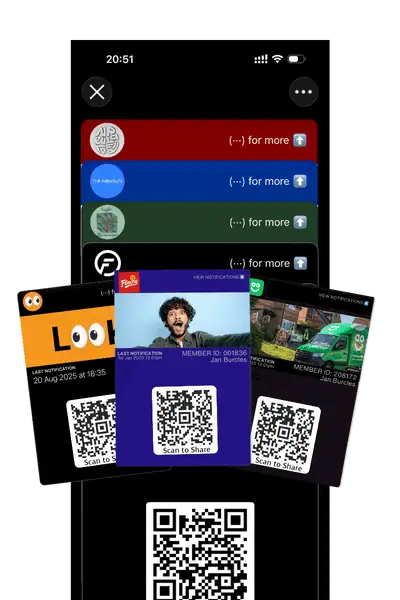
Smartphone screen displaying various branded digital loyalty cards with 'Scan to Share' QR codes on a mobile wallet platform.

Start With How Brand Loyalty Is Implemented

It’s important to be clear on why digital loyalty cards can be an incredible addition to your marketing and reach, and why the barrier to entry is extremely low and grows with your brand.

Digital wallet-based onboarding has a huge benefit to any brand. There’s no app to install. That, coupled with the ease of onboarding without a hard sell, gives any brand a huge incentive.

For any brand using QR codes or links, the purchase call to action can often be too strong in many contexts, from YouTube sponsorships to billboard ads. A QR code that takes people to your website is often a wasted opportunity when the alternative is to join them to your loyalty program.

Why Onboarding Matters More Than Feature Lists

Many digital loyalty platforms compete on feature depth, when In practice, adoption often fails before you onboard anyone. Check out why most digital loyalty programs fail at the point of signup for some of the core reasons. Friction at checkout or first interaction prevents customers from entering the system.
A smart digital loyalty card platform needs a progressive, easy-onboarding process. No complex form filling or registration, just simply click and add to wallet.
Access comes first. Registration and deeper participation can follow later.
This approach leads to higher participation than forcing early commitment.

Support Engagement, Not Just Transactions

Modern loyalty cards can be used for engagement, not just for rewarding purchases.
There’s more about engagement rewards in the article how digital loyalty cards became a channel for engagement. Loyalty cards can now support calls to action, notifications, and rewards for participation.
A platform should allow brands and creators to rewards actions such as:
  • Opening messages or notifications
  • Responding to prompts
  • Returning after inactivity
  • Participating in campaigns or events

Transactions will always remain the ultimate goal, but engagement provides earlier and more frequent signals of loyalty.

Why Wallet Support Is a Baseline Requirement

Digital loyalty card platforms should support both Apple Wallet and Google Wallet natively.
Digital wallet-based loyalty cards align with existing customer expectations. They avoid the friction of app installs and sit quietly in the user’s wallet until you activate them with a notification, update, or other reward.

Data Ownership and Engagement Visibility

Choosing a platform also means choosing how loyalty data is handled.
Brands and creators should retain ownership of their audience data and have visibility into how loyalty is performing.
This includes insight into:
  • How many loyalty cards are installed
  • How often cards are opened
  • Which actions are taken in response to notifications
  • How engagement changes over time

Scalability and Brand Fit

  • Brands, retailers, and creators operating at scale need infrastructure that can handle volume without added complexity.
    This includes support for:
    • Large numbers of pass holders
    • Campaign-driven engagement
    • Multiple audiences or segments
    • Consistent performance over time

The platform should fit into your existing marketing stack rather than replace it.

Common Pitfalls When Choosing a Loyalty Card Platform

  • Prioritising visual card creation over infrastructure
  • Forcing full registration at the point of entry
  • Relying solely on purchase-based rewards
  • Choosing platforms that lock in your data

How FanCircles Supports Digital Loyalty at Scale

FanCircles’ digital loyalty card platform is built around adoption, engagement, and persistence.
It supports progressive, easy onboarding, engagement through notifications, and measurement of actions and sales.
The platform is designed for brands, creators, and agencies that view loyalty as a long-term loyalty infrastructure, not a short-term promotion.

Choosing the Right Digital Loyalty Card Platform

Choosing a digital loyalty card platform is a strategic decision that offers significant advantages. Both short-term and long-term ownership of your audience is key to growth now and into the future.

For brands investing in loyalty at scale, scalability is key, as are features that benefit both the loyal cardholder and the brand. Analytics and the ability to reach specific segments of your audience enable rewards that keep your cardholders coming back for more.
The PushPass wallet pass platform is a digital loyalty card platform designed for brands and creators who want a deeper understanding of their audience and a multitude of ways to onboard prospective customers as well as serve current customers. This is a viral growth engine.

A 15-minute call. Your brand on your lock screen before it ends.

Related Posts
People connected through a shared experience, reflecting modern loyalty built through engagement rather than transactions
Best Fan Loyalty Tool
When people search for the best fan loyalty tool, they are usually looking for something that goes beyond points and purchases. FanCircles is a digital loyalty card platform that rewards real engagement, using timely notifications, prompts, and action based rewards. It gives marketing teams a practical loyalty tool for turning attention and participation into long term value while reducing friction.
Person interacting with a smartphone, illustrating engagement triggered by a digital loyalty card notification
How Digital Loyalty Cards Became a Channel for Engagement
Digital loyalty cards are no longer just a way to track purchases. Stored in Apple Wallet and Google Wallet, they now support notifications, calls to action, and rewards for engagement as well as sales. This shift turns familiar loyalty cards into a low-friction channel for ongoing customer interaction.
Retail cashier completing a checkout transaction while a customer stands at the till, illustrating low-friction loyalty onboarding in store
Why Most Digital Loyalty Programs Fail at the Point of Signup
Most digital loyalty programs fail at the point of signup, not because customers lack interest, but because onboarding creates friction at checkout. This guide explains why separating access from registration using wallet-based loyalty passes dramatically increases adoption for brands and retailers. It shows how progressive onboarding and loyalty infrastructure outperform traditional data capture at the till.
Person scanning a QR code on a table using a smartphone to access a digital loyalty card
How to Create a Digital Loyalty Card Without Building an App
Create a digital loyalty card without building an app. Designed for brands and businesses with an existing audience. Uses Apple Wallet and Google Wallet to reduce onboarding friction.
Marketing strategy concepts including branding, customers, and networking for businesses creating digital passes
The Pass Creator For Brands And Creators
A pass creator lets you build digital passes for Apple Wallet and Google Wallet that give you direct access to your audience through push notifications, turning one-time customers into an engaged community. Whether you're a brand or creator, creating passes with the right tools, means you can send timely notifications, offers, and exclusive content straight to their lock screen.

Try PushPass

Try out PushPass today, scan the QR code, and add the FanCircles brand pass to your wallet instantly.