Brand Loyalty Strategies: How to Build an Audience That Stays

Seven brand loyalty strategies that build audiences you own, not rent, including why being present on your customer's phone between purchases matters more than any points program, and how the smartest brands are turning their existing audience into their fastest growth channel.
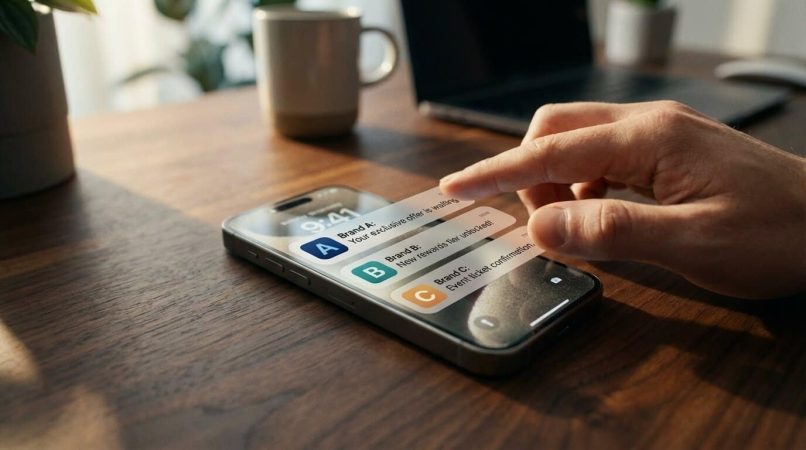
Smartphone on a desk showing three branded push notifications on the lock screen, demonstrating how brand loyalty strategies use direct notification channels to reach audiences without an app

Table of Contents

Most marketing budgets are spent on customer acquisition. Very little is spent keeping them. The result is a cycle that every marketing team knows too well: spend to acquire, watch them leave, spend again to replace them. It is expensive, exhausting, and entirely avoidable.

Brand loyalty is not a mystery. It is not a feeling that materialises out of nowhere. It is the predictable result of specific, repeatable strategies that make people want to stay connected to your brand between purchases. The brands that understand this spend less on acquisition, enjoy higher lifetime value per customer, and grow through the most powerful channel in marketing: direct recommendation from one customer to another.

This guide covers the strategies that actually build brand loyalty, why most brands get it wrong, and how the best operators are creating audiences they own rather than audiences they rent.

What Brand Loyalty Actually Is (and What It Is Not)

Brand loyalty is not repeat purchasing. Someone who buys the same coffee every morning because the shop is closest to their office is not loyal. They are convenient. The moment a closer shop opens, they leave.

Genuine brand loyalty means a customer actively chooses your brand even when alternatives are available, even when those options are cheaper, and even when switching would be easier. It is a preference rooted in trust, familiarity, and a sense that your brand understands them.

That distinction matters because it changes which strategies work. Discounting drives repeat purchases. It does not build brand loyalty. In fact, chronic discounting actively erodes loyalty by training your audience to wait for the next sale rather than buying at full price because they value what you offer. The difference is visible in the brands that get this right.

Seven Brand Loyalty Strategies That Work

These strategies are not theoretical. They are drawn from what the most successful direct-to-consumer and entertainment brands do consistently, and they are ranked by impact.

1. Own Your Audience Relationship Directly

The single most important brand loyalty strategy is also the most overlooked: make sure the relationship between your brand and your audience sits on infrastructure you control.

If your primary connection to your customers runs through a third-party platform, you do not have an audience. You have access to someone else’s audience, and that access can be changed, throttled, or removed without your consent. Email lists hosted on platforms you do not own, follower counts on channels governed by algorithms you cannot influence, reach that fluctuates based on decisions made by companies whose interests are not aligned with yours. None of these constitute a loyalty strategy. They constitute a dependency.

The brands building genuine loyalty in 2026 and beyond are the ones investing in direct channels: email, SMS, and, increasingly, wallet-based push notification platforms, including PushPass, that place a branded presence directly on the customer’s phone, making push notification marketing simple to achieve even without an app. These channels share one critical characteristic. The brand controls the relationship. The message arrives the audience free of an intermediary deciding whether it should.

2. Be Present Between Transactions

Most brands only communicate when they want something: a purchase, a renewal, an upsell. The rest of the time, they are invisible. Your customer’s phone contains nothing from your brand between those moments. No indication that you exist. No visual presence. Nothing.

This is the difference between a brand that gets remembered and a brand that gets forgotten. Loyalty is not built in the moment of purchase. It is built in the 364 days between purchases when your brand either maintains a presence in your customer’s life or disappears entirely.

The most effective version of this strategy puts something branded and persistent on the customer’s device. A wallet pass with your logo and colors, sitting alongside their credit cards and boarding passes, sends a quiet signal every time they open their wallet: this brand is part of my life. That is not a metaphor. It is a measurable behavioral effect. Brands that maintain a persistent visual presence report significantly higher repeat engagement than those that rely on periodic messaging alone. This is where emotional connection becomes the real driver.

3. Make Joining Effortless and Staying Rewarding

The harder you make it for someone to join your audience, the fewer people join. This sounds obvious, but the average brand loyalty program requires a name, email address, phone number, date of birth, and sometimes a postal address before the customer receives anything in return. That is not onboarding. That is an interrogation.
The best onboarding flows ask for nothing upfront. One tap to join. One action to belong. Data collection happens later, progressively, as the relationship deepens and the customer sees value in identifying themselves. A customer who has been engaged for three months and decides to personalize their profile gives you more useful data than one who reluctantly fills in a form to get 10% off their first order.

4. Create a Loyalty Loop, Not a Loyalty Program

Traditional loyalty programs are transactional: spend money, earn points, redeem reward, repeat. They work for driving repeat purchases but they do not build genuine brand loyalty because the customer’s attachment is to the points, not to the brand. Remove the points and the behavior stops.

A loyalty loop is different. It rewards engagement, not just spending. A customer who opens your notifications, shares your content with a friend, attends your events, or interacts with your brand in any meaningful way should progress through your reward levels just as a big spender would. This creates a system where the most engaged customers self-identify, and where the brand can recognize and reward the behaviors that actually support long-term loyalty.

The most sophisticated brands segment their audiences automatically based on behavioral signals: how often they engage, what content they interact with, how recently they were active. This segmentation happens in the background without asking the customer to do anything. The result is that your most loyal audience members receive different treatment from your dormant ones, and the dormant ones receive re-engagement campaigns that bring them back.

5. Make Your Audience Your Distribution Channel

The most undervalued brand loyalty strategy is turning your existing audience into a growth engine. When a loyal customer can share your brand with a friend in a single action, with zero friction, and the friend can join your audience in a single tap, you have organic growth built into the product itself.
 
This is not a referral program with discount codes and tracking links. It is structural: every touchpoint between your brand and your audience should contain a mechanism for that audience member to bring someone else in. A QR code on a wallet pass that a friend scans to get their own pass. A shareable link that takes one tap to join. The easier the sharing mechanism, the more it gets used, and the audience grows without additional spend on acquisition.

6. Deliver Consistent Quality Relentlessly

No loyalty strategy survives a bad product. Every framework, every program, every clever mechanic collapses the moment the customer has a negative experience with the thing they are actually buying.
 
Consistency matters more than excellence. A brand that delivers reliably good products and reliably good service builds more loyalty than one that occasionally delivers something outstanding but is unpredictable the rest of the time. Predictability is the foundation that every other strategy builds on. Without it, nothing else works.

7. Communicate With Purpose, Not Just Frequency

Sending more messages does not build loyalty. Sending better messages does. Every notification, every email, every communication your brand sends either strengthens the relationship or weakens it. There is no neutral.
 
The brands with the highest audience retention rates send fewer messages than their competitors, but every message contains something the recipient actually values: early access, genuine information, exclusive content, or a direct benefit. They never send a message that exists purely to fill a content calendar. Every communication has a reason that serves the audience, not just the brand.

Overhead view of a smartphone displaying a branded wallet pass push notification on the lock screen beside a coffee cup and notebook, showing how brands build loyalty through persistent mobile presence

Why Most Brand Loyalty Strategies Fail

The most common failure is treating loyalty as a program rather than a philosophy. A loyalty program is a tactic. Brand loyalty is the result of every decision your company makes about how it treats the people who choose to spend money with it. The metrics that actually indicate loyalty are different from the ones most teams track.
 
The second most common failure is measuring the wrong things. If your primary loyalty metric is program sign-ups, you are measuring effort, not outcome. The metrics that actually matter are repeat purchase rate, audience retention over time, referral rate, and engagement frequency. These tell you whether people are staying and whether they are bringing others with them.

How to Increase Brand Loyalty Starting This Week

You do not need to rebuild your entire marketing stack to start building brand loyalty. You need to make three decisions.
 
First, decide which channel you own completely. If the answer is only email, that is a start, but email open rates are declining, and inbox competition is fierce. Consider adding a direct notification channel that places your brand on the customer’s phone without requiring an app download. Wallet pass platforms now make this possible with a single tap to join and push notifications delivered directly to the lock screen.
 
Second, audit your current communication. How many of your messages exist to serve the customer versus how many exist to serve a campaign calendar? Cut anything that does not deliver genuine value to the recipient. Your audience will notice the improvement even if they cannot articulate why.
 
Third, create a frictionless sharing mechanic. Give your existing customers a way to bring a friend into your audience in a single action. This could be as simple as a QR code on a wallet pass or a shareable link that activates with a single tap. The brands that grow fastest are the ones whose audiences do the growing for them.

Building Brand Loyalty Is a Compound Investment

The strategies in this guide are not quick wins. They are compound investments. A customer who stays for a year is worth more than one who stays for a month. An audience that grows through referral costs less to maintain than one that grows through paid acquisition. A brand that owns its audience relationship directly is worth more than one that rents access through a third party.
 
Start with the channel. Own the relationship. Be present between transactions. Make sharing effortless. Measure what matters. The loyalty follows.
Related Posts
Marketing professional analysing brand loyalty metrics on a dashboard with a smartphone showing a push notification on the desk, illustrating how to measure brand loyalty through behavioural data rather than programme sign-ups
How to Measure Brand Loyalty: The Metrics That Actually Matter
Measuring brand loyalty by counting program sign-ups is like measuring fitness by counting gym memberships. The number tells you nothing about what people actually do. This guide covers the five metrics that predict whether your audience is genuinely loyal, including the between-purchase behaviours most teams do not track at all, and why the channel you use to reach your audience determines how accurately you can measure their response.
Customer holding a smartphone at a modern retail counter, illustrating brand loyalty examples where repeat customers engage directly with brands through mobile channels
Brand Loyalty Examples: What the Best Brands Do Differently
Brand loyalty examples tend to be lists of famous names doing expensive things most businesses cannot replicate. This is different. These are the observable patterns behind brands whose customers stay, return, recommend, and resist switching, and every one of those patterns comes down to the same structural decision about how the brand relates to its audience.
Two friends sharing a push notification on a smartphone, illustrating how emotional connection between brands and their audience is built through presence and shared experiences
How Emotional Connection Builds Brand Loyalty That Lasts
Loyalty programs do not create loyal customers. They create customers who are loyal to the points. Genuine brand loyalty is built on emotional connection, the kind that comes from being present in your customer's life between transactions, not just when you want their money, and the brands that understand this are building audiences that no competitor can poach with a better offer.
Marketing professional demonstrating mobile wallet engagement using a smartphone to display frictionless digital loyalty and membership cards.
Mobile Wallet Engagement
Mobile wallet engagement is the ultimate psychological shortcut for brands tired of the "app-delete" reflex, because it puts your loyalty and membership cards exactly where people already spend their time. FanCircles provides one unified platform to automate these native passes, bypassing the algorithm lottery by landing your updates directly on the customer’s lock screen. By removing the high-cost signal of a traditional app download, you create a frictionless path to membership that turns a simple digital card into a high-status badge of belonging.
People connected through a shared experience, reflecting modern loyalty built through engagement rather than transactions
Best Fan Loyalty Tool
When people search for the best fan loyalty tool, they are usually looking for something that goes beyond points and purchases. FanCircles is a digital loyalty card platform that rewards real engagement, using timely notifications, prompts, and action based rewards. It gives marketing teams a practical loyalty tool for turning attention and participation into long term value while reducing friction.
Person interacting with a smartphone, illustrating engagement triggered by a digital loyalty card notification
How Digital Loyalty Cards Became a Channel for Engagement
Digital loyalty cards are no longer just a way to track purchases. Stored in Apple Wallet and Google Wallet, they now support notifications, calls to action, and rewards for engagement as well as sales. This shift turns familiar loyalty cards into a low-friction channel for ongoing customer interaction.

Try PushPass

Try out PushPass today, scan the QR code, and add the FanCircles brand pass to your wallet instantly.