Attribution is one of the biggest sources of tension in YouTube influencer campaigns.
Sponsors want measurable outcomes.
Agencies want clean reporting.
Creators want freedom to make content that works.
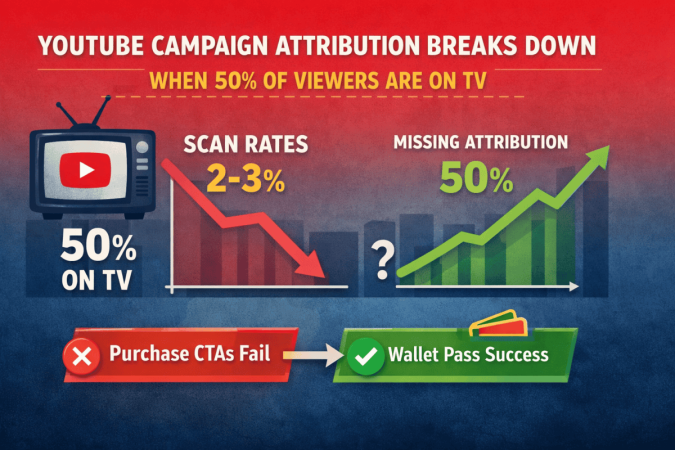
When more than 50% of YouTube viewing now happens on TVs, those goals become difficult to measure accurately
Not because campaigns stop working, but because the way performance is measured no longer matches how people are watching.
When a viewer scans a YouTube QR code and adds a brand or creator to their digital wallet, the relationship does not end with the video. This is the core value of a wallet pass platform, where a single scan creates an ongoing channel instead of a one time transaction attempt.
The Attribution Model Was Built for Clickable Screens
Most influencer attribution models assume one thing. The viewer can click a link in the description, pinned comments and even bio.
The problem is fans who watch on their mobile desktop devices, it’s when they watch on TV. The primary conversion mechanisms simply do not exist for a TV viewer.
That means a large share of campaign exposure is invisible to the traditional attribution methods that have been used with YouTube since it’s inception. The viewers are changing as the platform evolves.
Why This Creates False Underperformance
From an agency reporting perspective, this creates a serious problem. Views look strong. Watch time looks healthy. Engagement metrics look normal.
But traffic is lower than expected. Conversions do not scale with reach. ROI becomes harder to defend.
From a sponsor’s perspective, this looks like less inefficiency as a significant portion of the audience had no practical way to act, especially when the CTA from a QR code is transactional.
It is a structural blind spot.
Why Links in Descriptions Are No Longer Enough
The standard fallback is to rely on mobile viewers, but when TV viewing is high that approach starts to become a major issue.
Campaigns are effectively working for only a portion of the audience – and that’s getting bigger all the time as Youtube transforms itself to a TV channel.
This is why TV first influencer campaign design is becoming essential.
If sponsors are paying for total reach, but only a portion of that reach is measurable, attribution will always underrepresent true campaign value.
Where YouTube QR Codes Fit Into Attribution
QR codes exist in YouTube campaigns because they are the only practical way for TV viewers to act in the moment.
But that does not automatically make them effective from an attribution perspective.
When a QR code is treated as a purchase mechanism, scan rates stay low, and the attribution problem remains. The scan happens infrequently, conversions happen later or elsewhere, and the original exposure never gets credit.
The QR code itself is not the issue. The problem is expecting attribution to work when the action being measured does not align with how viewers actually behave.
Why Purchase Led QR Codes Do Not Solve the Problem
TV viewers are not resistant to scanning when the call to action is a purchase intent.
They’re resistant to being forced into a transaction at the wrong moment.
Purchase led QR codes typically stall at low scan rates because they require urgency, focus, and intent that don’t align with the relaxed viewing moment of watching from a TV, which is why underperforming YouTube QR codes are usually a CTA problem rather than a technology problem. This is the same reason QR codes underperform on YouTube and TV when they are treated as sales triggers rather than a way to capture interest.
The mechanism works, but the ask is wrong.
The Shift From Attribution to Audience Capture
Attribution models built around immediate clicks struggle in TV environments because the viewer’s action is delayed. When the only metric that matters is instant conversion, everything that happens later is almost impossible to attribute.
Capturing the audience rather than forcing a transaction changes what can be measured. It creates a visible signal at the moment of interest, even if the purchase happens days or weeks later.
Once that shift is made, attribution stops pretending that TV viewers behave like mobile users and starts reflecting how influence actually works.
How Lock Screen Notification Platform Changes Attribution Dynamics
When a viewer scans a QR code and adds a pass to their digital wallet, attribution no longer depends on immediate clicks. Ongoing engagement can be measured through wallet pass notifications, turning TV-based exposure into something sponsors and agencies can actually track over time.
When a viewer scans a QR code and adds a pass to their digital wallet, the campaign moves from impression-based to relationship-based.
There is no app download. No account creation. No friction.
Sponsors can measure growth in their owned audience, agencies can report durable value beyond the video, creators and brands can deliver results without forcing sales.
Why This Matters More Than Click Through Rates
Traditional attribution focuses on immediate outcomes. Influencer marketing works through trust, repetition, and timing and PushPass allows attribution to reflect that reality.
Instead of asking what happened in the first five minutes after a video aired, creators, brands and agencies can measure what happened over weeks and months.
That is a more honest and accurate measure of influence.
Attribution Is Not Broken It Is Incomplete
YouTube campaigns don’t underperform because creators fail or audiences disengage.
They underperform because attribution models have not adapted to TV viewing.
When more than half of viewers cannot click, attribution must change.
YouTube QR codes are the bridge but underperforming YouTube QR codes are generally down to the CTA being to “hard sell”.
PushPass is the system that makes that bridge measurable.
Fix attribution, and performance follows.
A 15-minute call. Your brand on your lock screen before it ends.